What Are the Five Elements?
ENERGY BASICS
The Five Elements are often introduced as Wood, Fire, Earth, Metal, and Water. At first, they may sound like five physical materials.
In traditional Chinese philosophy, however, they describe something broader: five recurring patterns through which nature, people, environments, and experiences move and change.
The Five Elements offer a language for observing growth, expression, stability, structure, and flow. Their value lies less in placing people into fixed categories and more in helping us notice how different forces interact within a larger whole.
Five elements, five movements
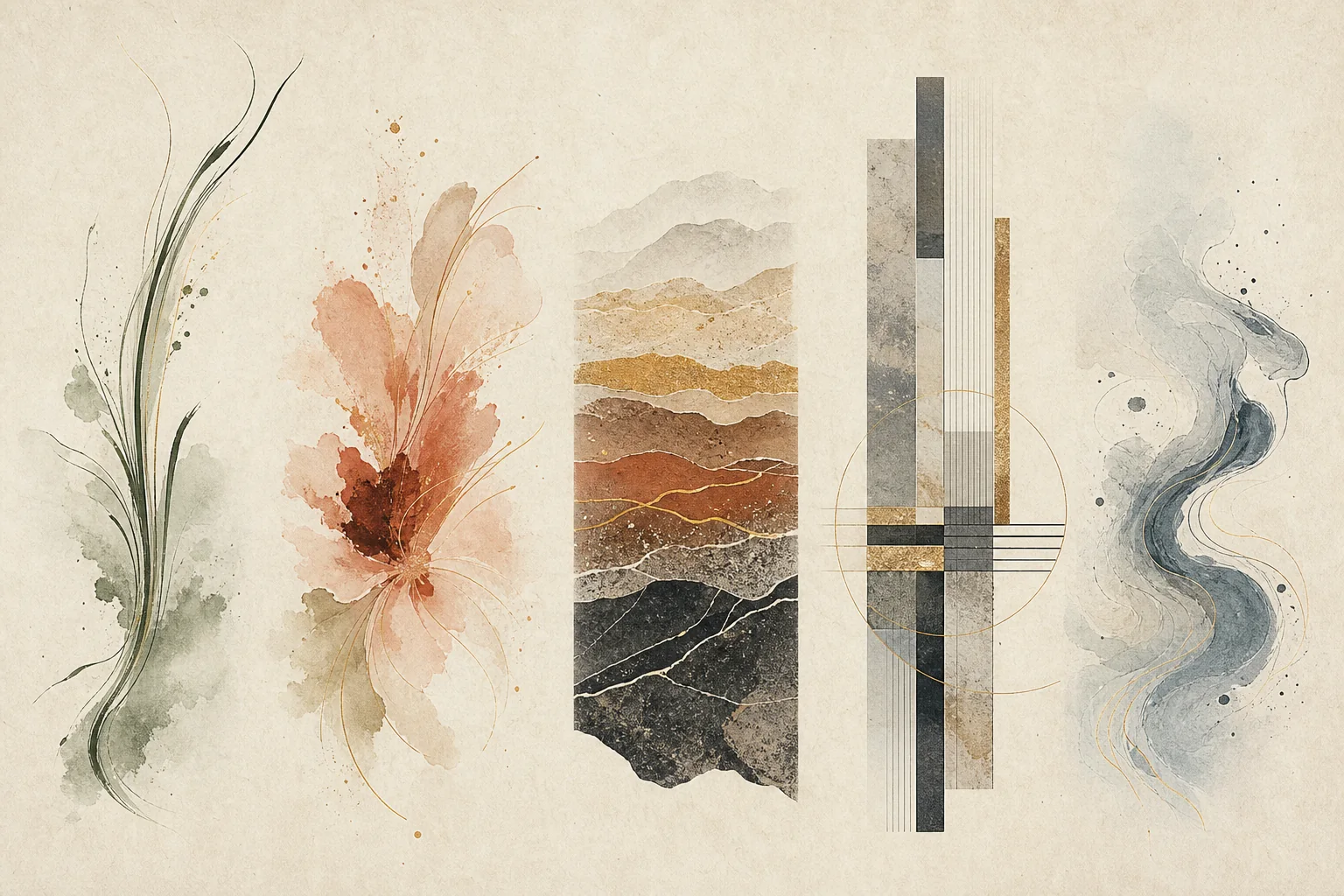
The Chinese term often translated as “Five Elements” is Wu Xing.
A more literal interpretation of xing is movement, phase, or way of acting. This is why the Five Elements are better understood as five dynamic tendencies rather than five static substances.
Wood does not only mean a tree.
Fire does not only mean a flame.
Earth is more than soil.
Metal is more than a material.
Water is more than a liquid.
Each element describes a recognizable way energy moves.
Wood: growth and direction
Wood represents growth, expansion, planning, and forward movement.
It can be seen in a seed pushing through the soil, a new idea taking shape, or a person feeling ready to develop beyond an old limitation.
Wood energy helps us imagine what could come next. It gives direction to change.
In daily life, Wood may appear as:
Curiosity and vision
The desire to improve
Planning and initiating
Flexibility and adaptation
Frustration when progress feels blocked
Wood asks: Where can life grow from here?
Fire: expression and connection
Fire represents warmth, visibility, expression, and outward movement.
It appears in enthusiasm, social connection, creativity, celebration, and the desire to bring something into the open.
Fire helps ideas become visible and emotions become shared. It creates momentum and draws attention.
In daily life, Fire may appear as:
Passion and excitement
Emotional openness
Creativity and performance
Social energy
Overstimulation when intensity becomes excessive
Fire asks: What is ready to be expressed?
Earth: support and stability
Earth represents nourishment, steadiness, responsibility, and the ability to hold things together.
It appears in routines, dependable relationships, practical care, and environments that help us feel settled.
Earth gives other forms of energy somewhere to land. It turns brief effort into something that can be sustained.
In daily life, Earth may appear as:
Reliability
Patience
Grounding routines
Care for others
Difficulty moving on when stability becomes attachment
Earth asks: What needs to be supported?
Metal: structure and refinement
Metal represents order, boundaries, discernment, and the ability to separate what is essential from what is not.
It appears in clear decisions, focused attention, well-designed systems, and the willingness to release what has completed its purpose.
Metal provides definition. It prevents growth and activity from becoming endless or chaotic.
In daily life, Metal may appear as:
Discipline and precision
Personal boundaries
Clear judgment
Organization
Rigidity when control becomes excessive
Metal asks: What should remain, and what can be released?
Water: flow and depth
Water represents adaptability, reflection, inner depth, and movement through uncertainty.
It can be quiet or powerful. It changes shape without losing its nature.
Water is associated with contemplation, intuition, imagination, and the ability to pause before acting.
In daily life, Water may appear as:
Reflection and insight
Emotional depth
Adaptability
Imagination
Withdrawal when inward energy becomes excessive
Water asks: What becomes visible when we become still?
The Five Elements work through relationship
No element operates alone.
Growth needs expression. Expression needs support. Support eventually creates structure.
Structure makes room for reflection. Reflection allows new growth to begin.
This relationship is traditionally described through two major cycles:
The generating cycle
The generating cycle describes support and continuation:
Wood feeds Fire
Fire creates Earth
Earth bears Metal
Metal supports Water
Water nourishes Wood
These images are symbolic. Their purpose is to show how one type of movement can prepare the conditions for another.
The regulating cycle
The regulating cycle describes boundary and restraint:
Wood regulates Earth
Earth regulates Water
Water regulates Fire
Fire regulates Metal
Metal regulates Wood
Regulation is not inherently negative. Boundaries, friction, and restraint are often what prevent one force from overwhelming the entire system.
Balance does not mean equal amounts of everything. It means that different forces can support, regulate, and respond to one another.
What does balance mean?
The Five Elements do not divide life into good and bad energy.
Every element has a useful expression and an excessive expression.
Growth can become restlessness.
Expression can become overstimulation.
Stability can become stagnation.
Structure can become rigidity.
Reflection can become withdrawal.
The aim is not to eliminate any one quality. It is to notice when a useful tendency has begun to dominate the whole system.
Balance is therefore dynamic. It changes according to our circumstances, environment, responsibilities, and stage of life.
Why are the Five Elements connected with people?
Traditional Chinese systems regarded people as part of nature rather than separate from it.
Human temperament, physical environment, seasons, relationships, and time were therefore understood through related patterns.
Some people naturally move quickly and initiate easily. Others need more time for reflection.
Some feel secure through structure, while others function best with flexibility.
The Five Elements offer a symbolic vocabulary for recognizing these differences.
They do not have to be used as permanent labels. A person may express different elements in different areas of life or at different moments.
The Five Elements in modern life
The world has changed, but the patterns remain recognizable.
We still move between:
Action and rest
Expression and privacy
Expansion and restraint
Stability and change
Clarity and uncertainty
The Five Elements give these tensions a visual and relational structure.
They can help us consider why a particular space feels calming, why certain routines provide stability, or why one period of life requires more movement while another asks for restraint.
Their modern relevance does not depend on treating them as unquestionable fact. They can also be approached as a traditional framework for reflection, one that encourages us to think in relationships rather than absolutes.
A language for noticing
The Five Elements begin with a simple idea:
Life is always moving.
Sometimes it grows.
Sometimes it expands outward.
Sometimes it gathers and supports.
Sometimes it refines and releases.
Sometimes it becomes quiet enough to change direction.
Learning the Five Elements gives us another way to observe these movements within ourselves and the world around us.
Continue exploring elemental balance
Related guides
Element Balance Without Superstition · How to Choose a Bracelet by Element
The Five Elements are presented here as a traditional symbolic framework for self-reflection and intentional living. Our jewelry and editorial content are not intended to diagnose, treat, prevent, or predict any medical, psychological, financial, or life outcome.